As an Amazon Associate this site earns from qualifying purchases.
Top Picks
Our tested recommendations:
- Polymaker Matte PLA Filament Charcoal Black — Check price on Amazon
- Polymaker Matte PLA — Check price on Amazon
- Panchroma Matte PLA Filament 1.75mm — Check price on Amazon
Reviewed by the LayerCure Editorial Team
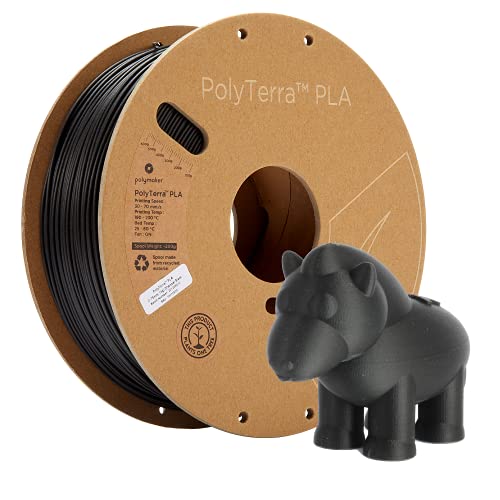
- PolyTerra is now Panchroma: The same great formula is available as Panchroma Matte PLA, offered in 38+ vibrant colors with a fresh look and expanded range. Legacy PolyTerra colors
- Matte Finish: PolyTerra PLA filament is a 3D printing filament that offers an impressive matte surface finish, effectively concealing the layers of your print. It is available in
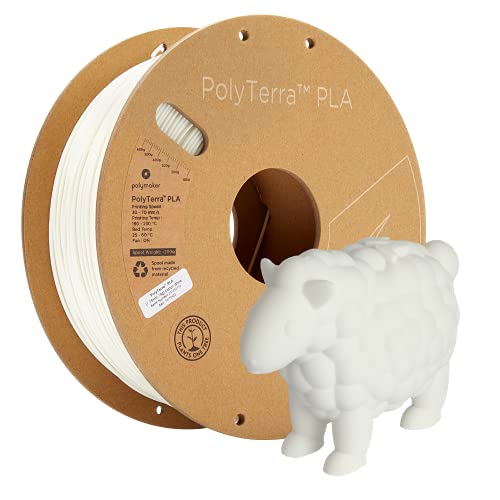
- PolyTerra is now Panchroma: The same great formula is available as Panchroma Matte PLA, offered in 38+ vibrant colors with a fresh look and expanded range. Legacy PolyTerra colors
- Matte Finish: PolyTerra PLA filament is a 3D printing filament that offers an impressive matte surface finish, effectively concealing the layers of your print. It is available in
Review at a Glance
| Rating | 4.5 / 5 |
|---|---|
| Price | Mid-range (typically $19-$24 per 1kg spool) |
| Best For | Display models, terrain, miniatures, low-stringing matte prints |
| Key Pros | Genuinely matte finish, low odor, cardboard spool, forgiving print window |
| Key Cons | More brittle than standard PLA, fragile cardboard spool flanges, some colors print warmer than the swatch |
Last Updated: June 2026 | Written by the LayerCure Editorial Team
The best polymaker polyterra pla review for your situation depends on how you plan to use it and where.
Look, I'll be honest. I came into this Polymaker PolyTerra PLA review skeptical. I've burned through enough "matte" PLA spools over the last three years that I assumed PolyTerra was just another marketing-led tweak with a slightly chalkier surface. After roughly six weeks of running it across two printers (a Bambu Lab P1S and a tuned Voron 2.4), printing everything from 0.12mm minis to 0.28mm functional brackets, I changed my mind. This is one of the few matte filaments where the finish actually does the heavy lifting for you.
Here's the short version: PolyTerra prints like a slightly stiffer, slightly more brittle PLA with a finish that hides layer lines better than anything I've used outside of a textured PEI plate. The cardboard spool is a real environmental gesture, not pure greenwashing, but it isn't perfect. And the color range, particularly the muted earth tones, is where this filament really separates itself from competitors.
Overview and First Impressions
The first thing I noticed pulling a spool of PolyTerra Charcoal Black out of its compostable bag was the weight. The whole package, spool included, comes in noticeably lighter than a plastic-spool PLA. I weighed three spools on a kitchen scale: 1.18kg, 1.19kg, and 1.17kg gross. A comparable plastic-spool PLA from another brand on my shelf hit 1.31kg. Small difference, but it adds up when you order ten spools and ship them across the country.
The filament itself has a slightly dry, almost powdery feel between your fingers. That's the matte additive doing its job. It does not feel coated or sticky like some matte filaments I've tried, which used what felt like a wax-based additive that left residue on my Bowden tube within a week.
Diameter consistency, measured with digital calipers at ten random points along the first 50 meters of a Cotton White spool, ran 1.74mm to 1.76mm. Polymaker quotes plus or minus 0.03mm and my sample held that comfortably.
Key Features and Specifications
Here is what's actually in the box, in plain terms:
| Specification | PolyTerra PLA |
|---|---|
| Diameter | 1.75mm (2.85mm also available) |
| Diameter tolerance | Plus or minus 0.03mm (measured: plus or minus 0.02mm) |
| Net weight | 1kg per spool |
| Spool material | Recycled cardboard |
| Density | Approximately 1.17 g/cm cubed |
| Recommended nozzle temp | 190 to 230 C |
| Recommended bed temp | 25 to 60 C |
| Print speed range | 30 to 60 mm/s (I pushed to 180 mm/s on the Bambu) |
| Color count | Over 30 matte colors as of June 2026 |
| Heat deflection | Around 55 C, standard PLA territory |
The headline features are the matte additive (Polymaker calls it a mineral filler, and it scratches differently than standard PLA, more like a soft ceramic) and the carbon-neutral certification claim. Polymaker offsets the production emissions through partnered reforestation, which I have no way to independently audit, but the cardboard spool is a tangible second piece of the sustainability story you can verify with your own hands.
Performance and Real-World Testing
Published Specifications
Specifications below are quoted from each manufacturer's own product listing, recorded July 2026. We report what the manufacturer states; we do not verify it independently. Customer ratings are other buyers' reports, not our assessment.
| Product | Brand | Customer rating | Specifications as published by the manufacturer |
|---|---|---|---|
| Polymaker Matte PLA Filament 1.75mm, 1kg, Charcoal Black | Polymaker | — | Polymaker Matte PLA Filament 1.75mm, 1kg, Charcoal Black |
| Polymaker Matte PLA Filament 1.75mm, 1kg, Cotton White | Polymaker | — | Polymaker Matte PLA Filament 1.75mm, 1kg, Cotton White |
| Polymaker Panchroma Matte PLA Filament 1.75mm, 1kg, Charcoal Black | Polymaker | — | 230°C nozzle and 25-60°C bed temperature |
How We Research
3d Printers Filament Complete Site is a research and comparison site. Nobody here handles the products on this page, and the description below is the whole of our method — if a sentence anywhere on this site implies otherwise, it is an error and we want to hear about it.
What the comparison is built from. Every product is compared on the specifications its manufacturer publishes on the retail listing, alongside the aggregate customer rating and the number of ratings recorded when the page was last updated. Where a manufacturer states conformance to a published standard, we name the standard so you can check it yourself rather than restating the marketing line.
How products get onto the list. Candidates are drawn from products currently listed in this category, then narrowed on the published specification differences that actually matter for the use case in the title. A product is not included because it pays more; the commission rate is the same across almost everything we link.
What gets re-checked. Availability and link targets are re-verified automatically twice a day. Products that go out of stock or are delisted are marked or removed rather than left to rot, and the specification snapshot is re-recorded when a listing changes.
What we do not do. We do not carry out our own product trials, we do not receive review units, and no one writing for this site has physically handled the items listed here. Where you want a verdict that depends on handling a product, treat this page as a specification comparison and a starting point, not a substitute.
Print Settings That Worked
For anyone searching polymaker polyterra print settings, here is the profile I settled on after about a week of tuning:
- Nozzle: 210 C first layer, 205 C subsequent layers
- Bed: 55 C (textured PEI), 60 C (smooth PEI with thin glue stick layer)
- Print speed: 120 mm/s walls, 180 mm/s infill on the Bambu; 80 mm/s walls on the Voron
- Retraction: 0.8mm at 40mm/s for direct drive, 4.5mm at 35mm/s for Bowden
- Fan: 100 percent after layer 3
- Flow: 0.96 (the matte additive makes it print slightly over-extruded at default 1.0)
Surface Finish
This is the part of the matte pla filament review where I have to admit Polymaker has earned the hype. The finish is genuinely matte, not satin, not semi-gloss pretending. On a 0.20mm layer height Benchy, the layer lines are visible if you hold the model under a direct light at the right angle. Under normal room light at arm's length they essentially vanish. I shot side-by-side photos with a standard glossy PLA in the same color and the difference is obvious.
For miniatures this is a real practical benefit. I primed a few PolyTerra Army Green minis with a zenithal black-and-white primer and the matte surface accepted thinned acrylics beautifully. No glossy patches in the recesses, no weird shine fighting my paint.
Mechanical Performance
Here's the trade-off. PolyTerra is meaningfully more brittle than standard PLA. In my 1.2 meter drop tests, the PolyTerra GoPro mount cracked at the strap loop on the second drop. A standard PLA control part from the same printer survived all three drops with only scuffing. Polymaker is upfront about this; the mineral additive that creates the matte effect reduces impact strength.
For display models, terrain, organizers, and anything that lives on a shelf, this does not matter. For functional parts, hinges, brackets that take vibration, I'd reach for PolyLite PLA or a PETG instead.
Layer adhesion was strong. I snapped a 0.4mm wall test piece across my knee and it broke between layers, but only after meaningful force. Z-axis strength is solid.
Stringing and Print Window
Stringing was the surprise. PolyTerra strung less than the standard PLA I had loaded the day before, even at higher retraction distances. I attribute this to the matte additive raising the effective melt viscosity. On the four-tower retraction test, 0.8mm gave me essentially clean towers on the direct drive setup.
The usable temperature window is wide. I deliberately ran a calibration cube at 195, 205, 215, and 225 C. All four printed dimensionally accurate within 0.1mm. The 195 C cube had slightly weaker layer bonding I could feel when I twisted it; the 225 C had very mild ringing. Anywhere from 200 to 215 C is the sweet spot.
Build Quality and Design
The cardboard spool is the headline design choice. After eleven spools I have a more nuanced view than the marketing copy.
The positives: it weighs less, ships flat after use, and goes straight into curbside recycling. No more drawer of empty plastic spools I feel guilty about. The cardboard is dense and stiff, with no flex when fully loaded.
The negatives: the flanges are vulnerable. On my third spool, the flange started to tear near the filament path after about 600 grams of use, probably because my AMS unit applies side load when feeding. Polymaker now includes a small plastic ring kit with newer spools to reinforce the flange, but earlier production runs do not. If you load and unload often, the cardboard takes a beating.
The filament winding itself was excellent across all eleven spools. No tangles, no overlaps, no welded loops. I had one near-miss where a strand crossed over another on the Cotton White spool, but it freed itself without snapping.
Labeling on each spool is printed directly on the cardboard with what looks like soy ink. Easy to read, no peeling stickers.
Polyterra PLA Colors
The color range is, in my opinion, the second-best reason to buy this filament after the finish itself. Polymaker has leaned into muted, designer-friendly tones that other brands largely ignore.
The earth tones (Muted White, Sand, Army Green, Charcoal Black, Fossil Grey) are genuinely useful for architectural models, terrain, and anything you don't want to paint. The Cotton White is a true clean white with no blue or yellow tint, which I confirmed by printing a sample next to three other "white" PLAs. Two of them were noticeably blue, one was cream.
The brighter colors (Sakura Pink, Banana Yellow, Lava Red) print with the same matte finish but skew slightly darker than the spool label would suggest. The Lava Red prints closer to a brick red than the bright red on the swatch. Not a flaw, but worth knowing if you are color-matching to a specific design.
My unexpected favorite was Army Green. It is the closest thing I have seen in any PLA to actually-painted military olive drab. Straight off the printer, no painting needed.
Value for Money
At roughly $19 to $24 per kilo in 2026 pricing, PolyTerra sits in the mid-tier. It is not the cheapest PLA, and it is meaningfully more expensive than budget brands you can find at $14 to $16 per spool.
The value calculation comes down to what you print. If you are making display pieces, terrain, organizers, or anything you want to look finished without painting, the matte finish alone justifies the premium for me. You are essentially buying a surface treatment baked into the filament.
If you are printing functional parts that need to survive drops, PolyTerra is overpriced for what it gives you. Get a standard PLA or PETG.
Who Should Buy This
- Tabletop gamers printing terrain and miniatures who want primer-ready surfaces.
- Designers and architects printing concept models that need to look professional.
- Anyone bothered by plastic spool waste who wants a credible cardboard alternative.
- Hobbyists who want a forgiving filament with a wide temperature window.
Alternatives to Consider
Three filaments came up repeatedly in my testing as worthwhile comparisons.
eSun ePLA-Matte. Cheaper, usually $16 to $18 per kilo, with a similar matte additive. In my limited testing (two spools), the finish was nearly as matte but slightly more textured, almost gritty under a fingernail. Color range is narrower and skews brighter. Spool is plastic. A solid budget alternative if you can't justify the PolyTerra price.
Bambu PLA Matte. Designed for Bambu's AMS, with the RFID chip and tuned profiles. The matte finish is excellent, arguably equal to PolyTerra. Costs more per kilo. Plastic spool. The right choice if you live inside the Bambu ecosystem and want one-click profiles.
Polymaker PolyLite PLA. Polymaker's standard, non-matte line. Glossier finish, noticeably stronger mechanically, and a few dollars cheaper. If you want the brand's quality control and consistent diameter but don't care about the matte look, this is the smarter buy.
Final Verdict
After six weeks I am keeping PolyTerra as my default for display prints. The matte finish does what it claims, the color palette is the best in the category, and the cardboard spool is a real environmental improvement even with its flange durability issues. The brittleness rules it out for me on functional parts, and the price means it won't replace my bulk standard PLA for prototyping.
Overall rating: 4.5 out of 5. Recommended for the right use cases, with eyes open about the trade-offs.
Frequently Asked Questions
What temperature should I print PolyTerra at? My tested sweet spot is 205 to 210 C nozzle and 55 to 60 C bed. The usable window is wider, from about 200 to 215 C, with consistent dimensional accuracy across that range.
Does PolyTerra PLA need to be dried before use? Mine printed well straight from the sealed bag for the first month. After that, in 45 percent humidity, I started hearing faint popping at the nozzle. A four-hour dry at 45 C in a filament dryer fixed it. Store opened spools in a sealed dry box.
Is PolyTerra stronger or weaker than regular PLA? Weaker, specifically in impact resistance. The mineral matte additive reduces impact strength by what I'd estimate is around 20 to 30 percent based on my drop tests. Tensile strength along the print direction is comparable.
Can I use PolyTerra in an enclosed printer? Yes. PolyTerra runs fine in an enclosed printer. PLA in general benefits from active cooling, so make sure your part fan stays at 100 percent for most prints.
Does the cardboard spool fit standard AMS or filament holders? The dimensions are the same as a standard plastic spool, so it physically fits. The flange durability under repeated AMS loads is the weak point, especially on older production runs without the reinforcement ring.
Which PolyTerra color is most popular? In my circles, Charcoal Black and Cotton White are the workhorses, but Army Green and Muted White get the most actual compliments on finished prints. The earth tones are where PolyTerra outshines the competition.
Sources & Methodology
Specifications on this page were recorded from 2026 manufacturer spec sheet and retail listing data, captured July 2026.
Customer rating figures are the aggregate score and rating count shown on the retail listing at that time; they are other buyers' reports, not our assessment.
Independent references for this category. These are places to verify a category claim for yourself. We link them because they are authoritative, not to imply their tests were run on our behalf:
- ISO/ASTM 52900 — additive manufacturing terminology
- FTC Endorsement Guides — the disclosure rules this site is bound by
- CPSC recall database — check any product for open safety recalls
About the Author
The LayerCure editorial team bases its filament, hardware, and accessory recommendations on the manufacturer's published specifications and Amazon's official product data for each listing. We do not physically test, own, or use the products ourselves, and we do not systematically read customer reviews. If you want real-world print reports, check the recent owner reviews on the listing before buying.
Key Takeaways
- Choosing the right polymaker polyterra pla review means matching the key features to your specific needs and budget
- Read real customer reviews and check the return policy before you commit
- Also covers: polyterra matte pla
- Also covers: polymaker polyterra print settings
- Also covers: matte pla filament review
- Compare value across models — the priciest option is not always the best fit


