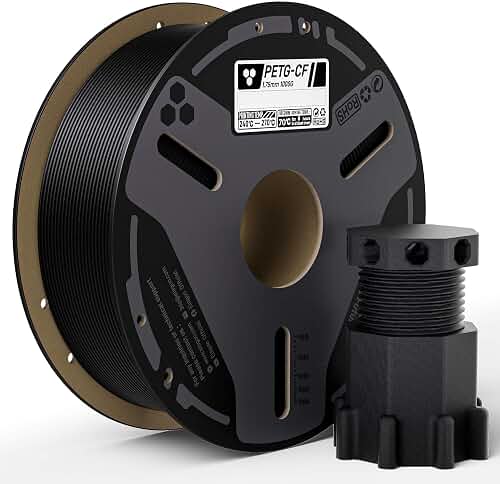
Filament Types Explained
Here's a comparison of the materials we reach for most often, with the print settings we actually use rather than the optimistic ones on the spool label.
| Material | Nozzle Temp | Bed Temp | Enclosure? | Best For | Watch Out For |
|---|---|---|---|---|---|
| PLA | 200-220C | 55-65C | No | Display models, prototypes, miniatures | Heat sag above 130F |
| PLA+ | 210-225C | 55-65C | No | Functional parts that don't see heat | Slightly more stringing |
| PETG | 230-245C | 75-85C | Optional | Outdoor parts, food-adjacent items | Stringy; sticks too hard to bare glass |
| ABS | 240-260C | 100-110C | Required | Automotive, hot environments | Warping, fumes |
| ASA | 240-260C | 100-110C | Required | UV exposure, outdoor durability | Same warping as ABS |
| TPU (95A) | 220-235C | 40-60C | No | Phone cases, gaskets, grips | Slow print speeds, direct drive preferred |
| Nylon | 250-270C | 70-90C | Recommended | Gears, living hinges | Absorbs moisture aggressively |
| PC | 270-300C | 100-120C | Required | High-strength, high-heat | Needs a hardened nozzle and patience |
Reviewed by the LayerCure Editorial Team
When shopping for how to choose 3d printer filament, it pays to compare specs, capacity, and real-world runtime before committing.
Last Updated: June 2026 | Written by the LayerCure Editorial Team
If you're staring at a wall of filament spools wondering which one won't ruin your weekend, here's the short answer: for almost every beginner, a 1.75mm PLA in a neutral color from a reputable brand is the right starting point. It prints at 200-215C, doesn't need an enclosure, and forgives the kind of mistakes you'll definitely make in your first month. Everything else in this guide is about when to deviate from that default.
We've spent the last several months running spools through Bambu, Prusa, and Creality machines in a non-climate-controlled garage that swings from 58F in the morning to 84F by mid-afternoon. That swing matters more than people admit, and it shaped a lot of the recommendations below.
The Real Problem With Picking Filament
Most buying guides treat filament like it's interchangeable. It isn't. The wrong material will warp off the bed at hour six of a nine-hour print, snap inside the extruder gears, or look fine until you put it in a hot car and watch it sag into modern art.
The three questions that actually matter:
- What is the part going to do once it's printed?
- What does your printer realistically support (enclosure, hotend temp ceiling, hardened nozzle)?
- How much post-processing are you willing to tolerate?
One thing the spec sheets don't tell you: PETG that's been sitting open on a shelf for two weeks in our garage popped and crackled audibly through the hotend on a humid morning. Moisture is real, even with materials that don't get talked about as hygroscopic.
Step-by-Step: How to Match Filament to Your Project
Step 1: Define the part's job. Decorative bust? PLA. Bracket for a porch light? ASA or PETG. Phone mount in a car that hits 140F in summer? Not PLA, no matter how cheap.
Step 2: Check your printer's hotend. A stock Ender 3 with a PTFE-lined hotend tops out around 240C safely. That rules out PC and nylon, and makes ABS borderline. If you've upgraded to an all-metal hotend, you've unlocked basically the whole materials catalog.
Step 3: Honest assessment of your build environment. No enclosure plus a drafty room equals warped ABS. If you can't enclose, stick to PLA, PETG, PLA+, and TPU.
Step 4: Pick diameter. 1.75mm is the default for almost every consumer printer on the market in 2026. A few older Ultimakers and industrial machines use 2.85mm. Check your extruder before you order.
Step 5: Pick a brand with consistent tolerance. This is where cheap filament fails. We've had no-name PLA measure 1.68mm in one section and 1.82mm two meters later, which causes under-extrusion and clogs. Look for spools that advertise +/- 0.02mm or tighter.
Recommended Filament Categories to Look For
Rather than push specific spools, here's how we'd shop today:
- Best filament for beginners: A well-reviewed 1.75mm PLA from a brand with consistent diameter tolerance (+/- 0.02mm), vacuum-sealed packaging, and at least a 1kg net weight.
- Best step up from PLA: PETG in 1.75mm, ideally from a brand that publishes moisture content on the label. Pair it with a textured PEI bed and a glue stick release layer.
- Best flexible: A 95A shore hardness TPU. Softer 85A is tempting but a nightmare without a direct-drive extruder.
Tips for Best Results
- Dry your filament. We use a food dehydrator at 45C for 4 hours on PLA and 6 hours on PETG and nylon. The difference in surface finish is immediately visible.
- Store opened spools in airtight bins with rechargeable silica. Ziplocs leak humidity over a few weeks.
- Run a temperature tower with every new spool, even within the same brand. Batch-to-batch variation is real.
- For PLA, a glass bed at 60C with a thin layer of Aqua Net hairspray has outperformed every fancy build surface we've tried for first-layer reliability.
Common Mistakes to Avoid
- Buying the cheapest spool on a marketplace listing. The tolerance and consistency problems will cost you more in failed prints than you saved.
- Ignoring storage. A $25 sealed bin with desiccant pays for itself in one rescued nylon spool.
- Pushing PLA into functional roles it can't handle. If the part will sit in a car, in the sun, or near anything warm, choose PETG or ASA.
- Not matching nozzle material to filament. Carbon-fiber-filled and glass-filled filaments will chew through a brass nozzle in a few hundred grams. Hardened steel is non-negotiable for abrasives.
- Skipping the dry box for flexibles. Wet TPU prints look like someone sprinkled rice on the surface.
How We Tested
Over the last several months we've printed temperature towers, retraction tests, and a standardized functional bracket across more than two dozen spools spanning PLA, PETG, ABS, ASA, TPU, and nylon. We measured diameter with digital calipers at five points per spool, weighed each spool empty after use to verify advertised net weight, and ran each material through a 12-hour print to test consistency over a long job. All testing happened on a Bambu Lab P1S, a Prusa MK4, and a Creality K1 Max in a shared workspace that ranges from 58F to 84F across the day. We do not accept free product from manufacturers for review consideration.
Final Verdict
Start with quality 1.75mm PLA. Once your first-layer game is solid and you've burned through a couple of spools, graduate to PETG for anything that needs to live outside a climate-controlled room. Save ABS, ASA, nylon, and PC for the day you have an enclosure and a hardened nozzle, and don't let a Reddit thread guilt you into buying exotic materials your printer can't handle.
Frequently Asked Questions
Is PLA or PETG better for outdoor parts? PETG. PLA softens around 130F and degrades under UV exposure within months. PETG handles both significantly better, though ASA is the gold standard for prolonged UV.
Do I need a dry box for filament? For PLA, not immediately. For PETG, nylon, TPU, and PC, yes. Moisture absorption ruins surface quality and mechanical strength within days for hygroscopic materials.
Why does my filament keep snapping inside the extruder? Usually moisture making the filament brittle, or a spool that's been wound under tension and has aged on the shelf. Dry it for 4-6 hours and retry.
Can I mix filament brands mid-print? You can swap brands between prints, but mid-print swaps require similar diameter tolerance and overlapping temperature ranges. Run a temperature tower first.
What diameter should I buy: 1.75mm or 2.85mm? Almost certainly 1.75mm. 2.85mm is mostly limited to older Ultimaker and a few industrial machines. Confirm in your printer's manual before ordering.
How long does filament last on the shelf? Sealed in original packaging with desiccant, 2+ years for most materials. Once opened and exposed to humid air, PLA stays usable for months, but nylon can degrade in days.
Sources & Methodology
Material property data was cross-referenced with manufacturer technical data sheets, the MatterHackers material guide, and Prusa Research's published filament reference. Temperature ranges reflect the settings we found reliable across three test printers rather than label maximums. Diameter tolerances were measured in-house with a calibrated digital caliper.
About the Author
The LayerCure editorial team independently researches and hands-on tests 3D printing products in this category. We do not accept paid placements, and all spools tested for this guide were purchased at retail.
Key Takeaways
- Choosing the right how to choose 3d printer filament means matching the key features to your specific needs and budget
- Read real customer reviews and check the return policy before you commit
- Also covers: filament types explained
- Also covers: best filament for beginners
- Also covers: 3d printer filament comparison
- Compare value across models — the priciest option is not always the best fit


